Myth and Archetype from a Female Perspective: An Exploration of Twentieth Century North and South American Women Poets
PhD Dissertation Abstract, New York University
1980
346 pages
Published by University Microfilms International, Publication # 8017574
HELANE LEVINE- KEATING, PH.D.
Advisor: Professor Erika Ostrovsky
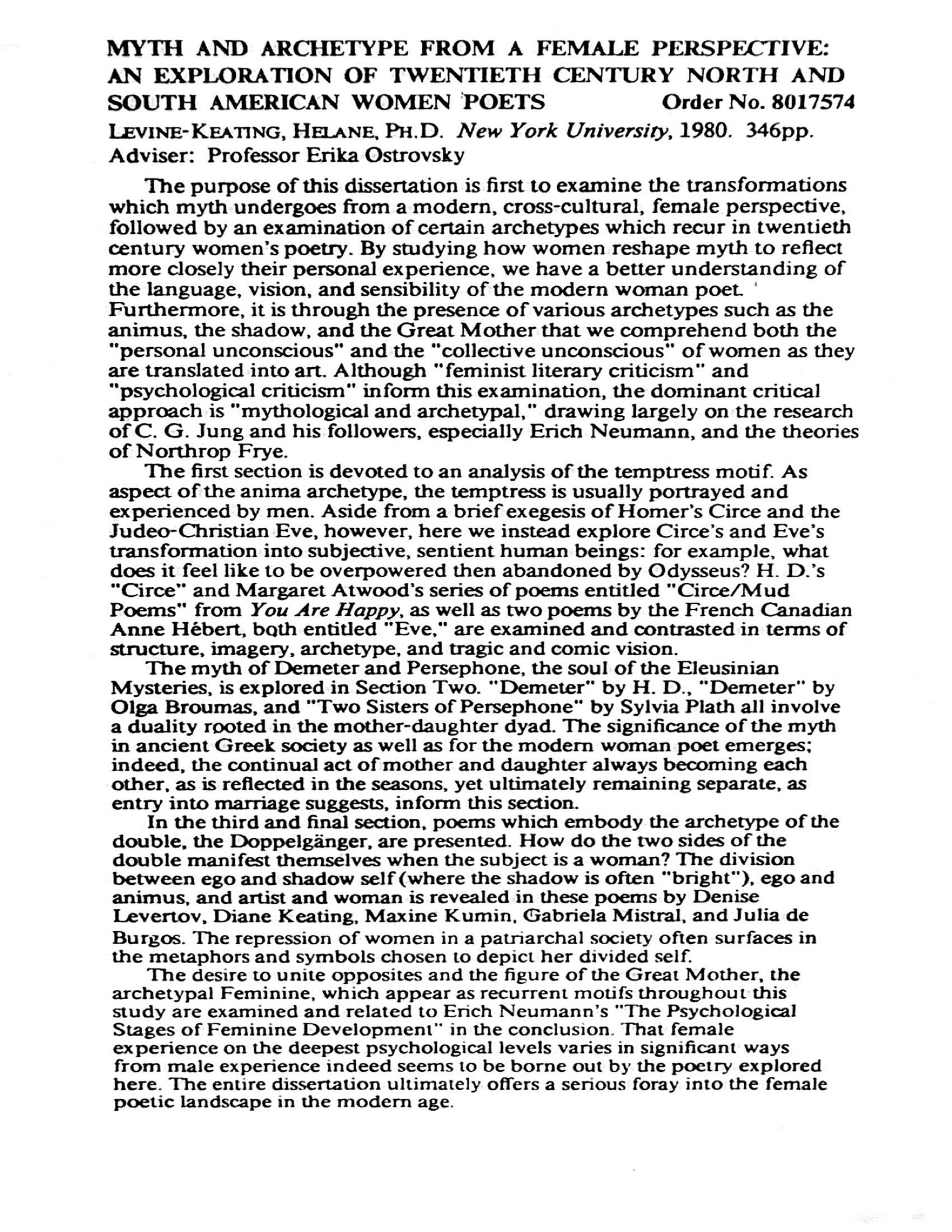
The purpose of this dissertation is first to examine the transformations which myth undergoes from a
modern, cross-cultural, female perspective, followed by an examination of certain archetypes which
recur in twentieth century women's poetry. By studying how women reshape myth to reflect more closely
their personal experience, we have a better understanding of the language, vision, and sensibility of
the modern woman poet.
Furthermore, it is through the presence of various archetypes such as the
animus, the shadow, and the Great Mother that we comprehend both the "personal unconscious" and the
"collective unconscious" of women as they are translated into art. Although "feminist literary criticism"
and "psychological criticism" inform this examination, the dominant critical approach is "mythological and
archetypal," drawing largely on the research of C.
G. Jung and his followers, especially Erich Neumann, and the theories of Northrop Frye.
The first section is devoted to an analysis of the temptress motif. As aspect of the anima archetype,
the temptress is usually portrayed and experienced by men. Aside from a brief exegesis of Homer's Circe
and the Judeo-Christian Eve, however, here we instead explore Circe's and Eve's transformation into subjective,
sentient human beings: for example, what does it feel like to be overpowered then abandoned by Odysseus? H. D.'s
"Circe" and Margaret Atwood's series of poems entitled "Circe/Mud
Poems" from You Are Happy, as well as two poems by the French Canadian Anne Hebert, both entitled
"Eve. " are examined and contrasted in terms of
structure, imagery, archetype, and tragic and comic vision.
The myth of Demeter and Persephone, the soul of the Eleusinian Mysteries, is explored in Section Two.
"Demeter* by H. D., "Demeter" by Olga Broumas, and "Two Sisters of Persephone" by Sylvia Plath all
involve a duality rooted in the mother-daughter dyad. The significance of the myth in ancient Greek
society as well as for the modern woman poet emerges: indeed, the continual act of mother and daughter
always becoming each other, as is reflected in the seasons, yet ultimately remaining separate, as
entry into marriage suggests, inform this section.
In the third and final section, poems which embody the archetype of the double, the Doppelgänger,
are presented. How do the two sides of the double manifest themselves when the subject is a woman?
The division between ego and shadow self (where the shadow is often "bright"), ego and animus, and
artist and woman is revealed in these poems by Denise Levertov, Diane Keating, Maxine Kumin, Gabriela
Mistral, and Julia de Burgos. The repression of women in a patriarchal society often surfaces in the
metaphors and symbols chosen to depict her divided self.
The desire to unite opposites and the figure of the Great Mother, the archetypal Feminine, which appear as
recurrent motifs throughout this study are examined and related to Erich Neumann's "The Psychological Stages
of Feminine Development" in the conclusion. That female experience on the deepest psychological levels
varies in significant ways from male experience indeed seems to be borne out by the poetry explored here.
The entire dissertation ultimately offers a serious foray into the female poetic landscape in the modern age.