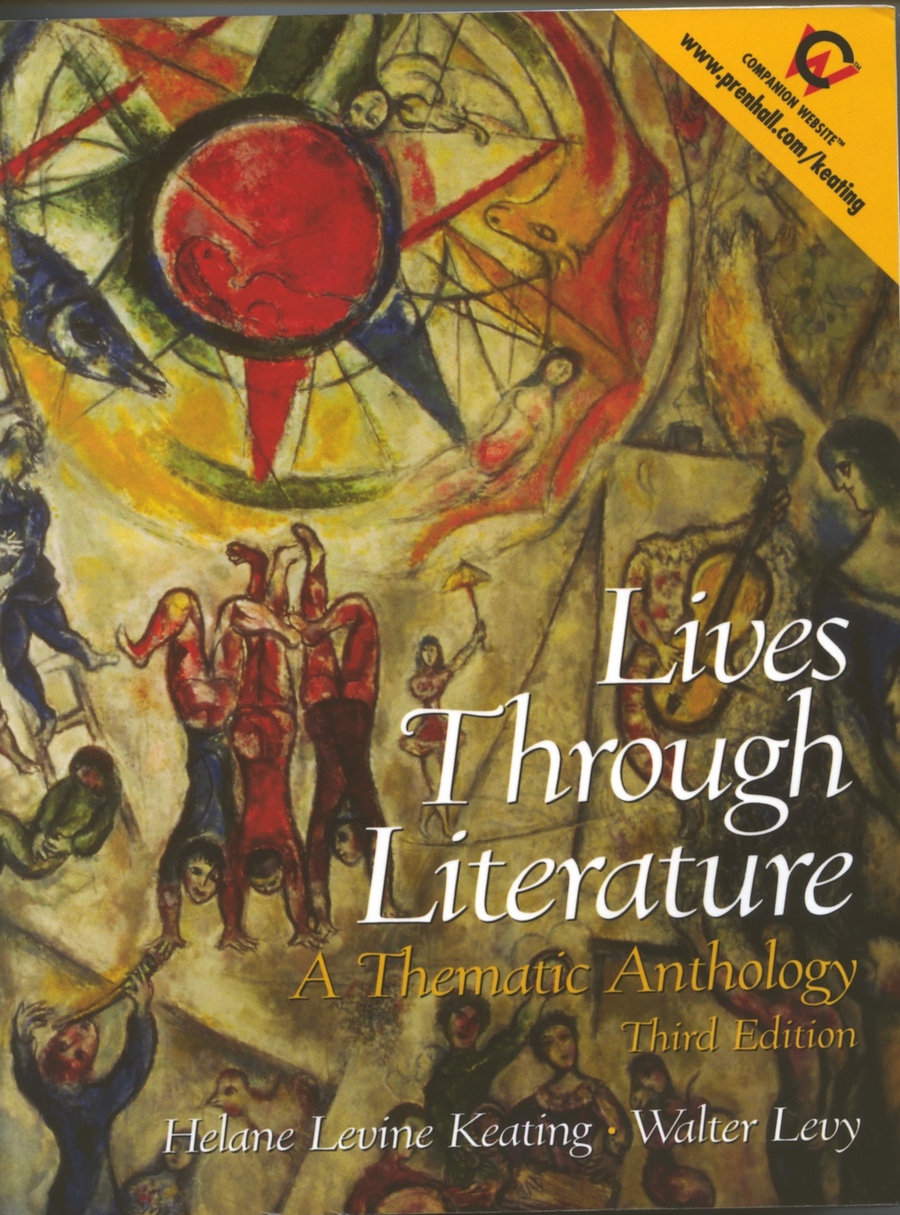
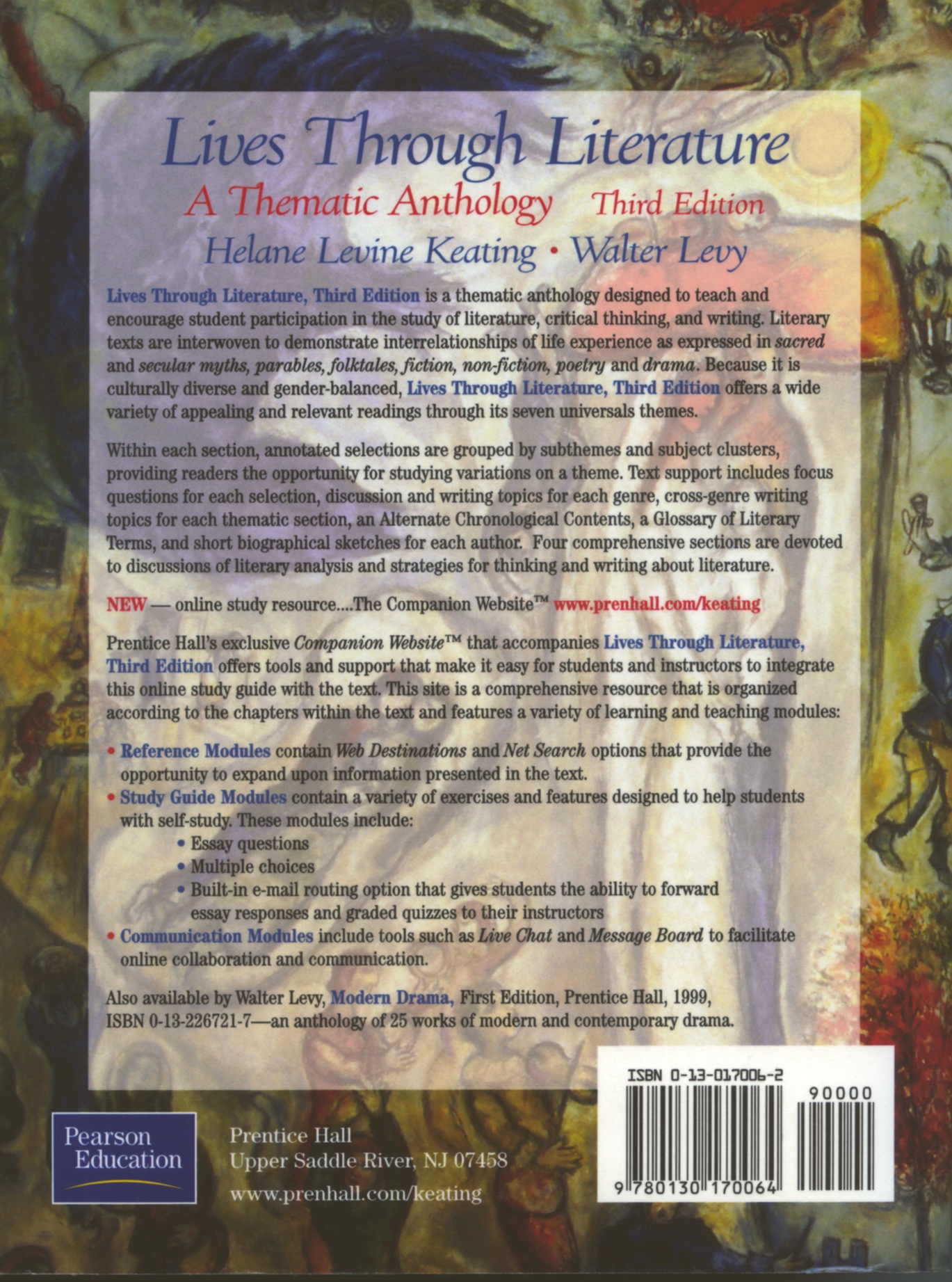
Lives Through Literature:
A Thematic Anthology
(co-author: Walter Levy)
Prentice-Hall Publishing Company, Pearson
Editions 1991, 1995, 2001
xxx pages, softcover
$14.99
EU - ORDER NOW FROM BLACKWELL'S
ABOUT· EDITIONS
SYNOPSIS
This culturally diverse, gender-balanced anthology is organized
by seven types of human relationships: Parents and Children, Sisters and Brothers, Women
and Men in Love, Wives and Husbands, Friends and Enemies, Students and Teachers, and
People Alone. Within each category, readings are also grouped by subthemes and subject
clusters - often based on essential mythical or biblical themes. The text also features
four example - filled chapters on reading skills, critical analysis, and writing about
literature. For anyone - regardless of age, culture, or gender - in need of a catalyst
to generate dynamic literary discussion and stimulating writing topics.
PREFACE TO THE THIRD EDITION
Our debt to tradition through reading and conversation is so
massive, our protest or private addition so rare and insignificant
- and this commonly on the ground of reading or hearing
- that, in a large sense, one would say there is no pure
originality. All minds quote. Old and new make the warp and
woof of every moment.
— Ralph Waldo Emerson's "Quotation and Originality"
Lives Through Literature is designed to teach literature and encourage
writing. It is a thematic anthology interweaving literary texts that
demonstrate interrelationships of life experience as expressed in both
sacred and secular myths, parables, folktales, fiction, nonfiction,
poetry, and drama. The anthology is aimed primarily at students in the
freshman and sophomore English sequences. Selections are drawn from many
civilizations and cultures so that we provide a solid core of world
literature from the ninth century B.C.E. to the present. We hope that
this anthology becomes a catalyst for critical thinking and writing, as
well as a source of multicultural literacy.
But there remains the indefeasible persistency of the individual
to be himself. One leaf, one blade of grass, one meridian,
does not resemble another. Every mind is different; and the
more it is unfolded, the more pronounced is that difference.
— Ralph Waldo Emerson, "Quotation and Originality"
We have chosen seven universal themes that we believe are immediately
appealing and relevant to our students' experience as well as to the
instructor's experience: Parents and Children, Sisters and Brothers,
People in Love, Wives and Husbands, Friends and Enemies, Students and
Teachers, and People Alone. Since it is likely that these are the very
relationships students are struggling with as they enter and proceed through
college, we believe that literature of both immediate and lasting relevance
will encourage their active participation in the study of literature and
critical thinking and writing. The variety of selections included within
each theme reveal a multiplicity of points of view as reflected in the
differences in age, culture, class, gender, ethnicity, race, religion,
sexual orientation, and philosophy.
The themes are arranged in a progressive order that loosely follows the
path of growth and development that is an integral part of the process of
maturation and individuation. Within each theme, material is grouped by
genre, and within each genre material is organized to create a dialogue
between selections that precede or follow. Part 1, "Parents and Children,"
focuses on aspects of relationships between parents and children from the
perspective of each, such as coming of age, separation, and death. Part 2,
"Sisters and Brothers," portrays the nature of sibling loyalty, jealousy,
rivalry, and competitiveness. Part 3, "People in Love," and Part 4,
"Wives and Husbands," differentiate the experience of love from that
of marriage. Focuses include the role time and timing plays in
relationships, the experience of falling in love, the nature of love
when both partners are single or married, the difficulties caused
by unrequited love or love outside a marriage, and so on. Our intent
is not to imply that love and marriage are mutually exclusive, but to
suggest that they are complex subjects with many facets for analysis
and interpretation. Part 5, "Friends and Enemies," explores different
types of friendship and the sources of enmity that arise between friends
or explode between foes. Part 6, "Students and Teachers," raises
fundamental questions regarding how and from whom we learn, the nature
of the lesson, and the profound connection between students and
teachers. Finally, we have added to the third edition Part 7,
"People Alone" which addresses the singularity of the individual in
society and family, one's relationship with oneself rather than with
others, the distinction between solitude and loneliness, and the ways
in which individuals face death.
Some collaboration has to take place in the mind between
the woman and the man before the act of creation can be accomplished.
Some marriage of opposites has to be consummated. The whole mind
must lie wide open if we are to get the sense that the writer is
communicating his experience with perfect fullness.
— Virginia Woolf, A Room of One's Own