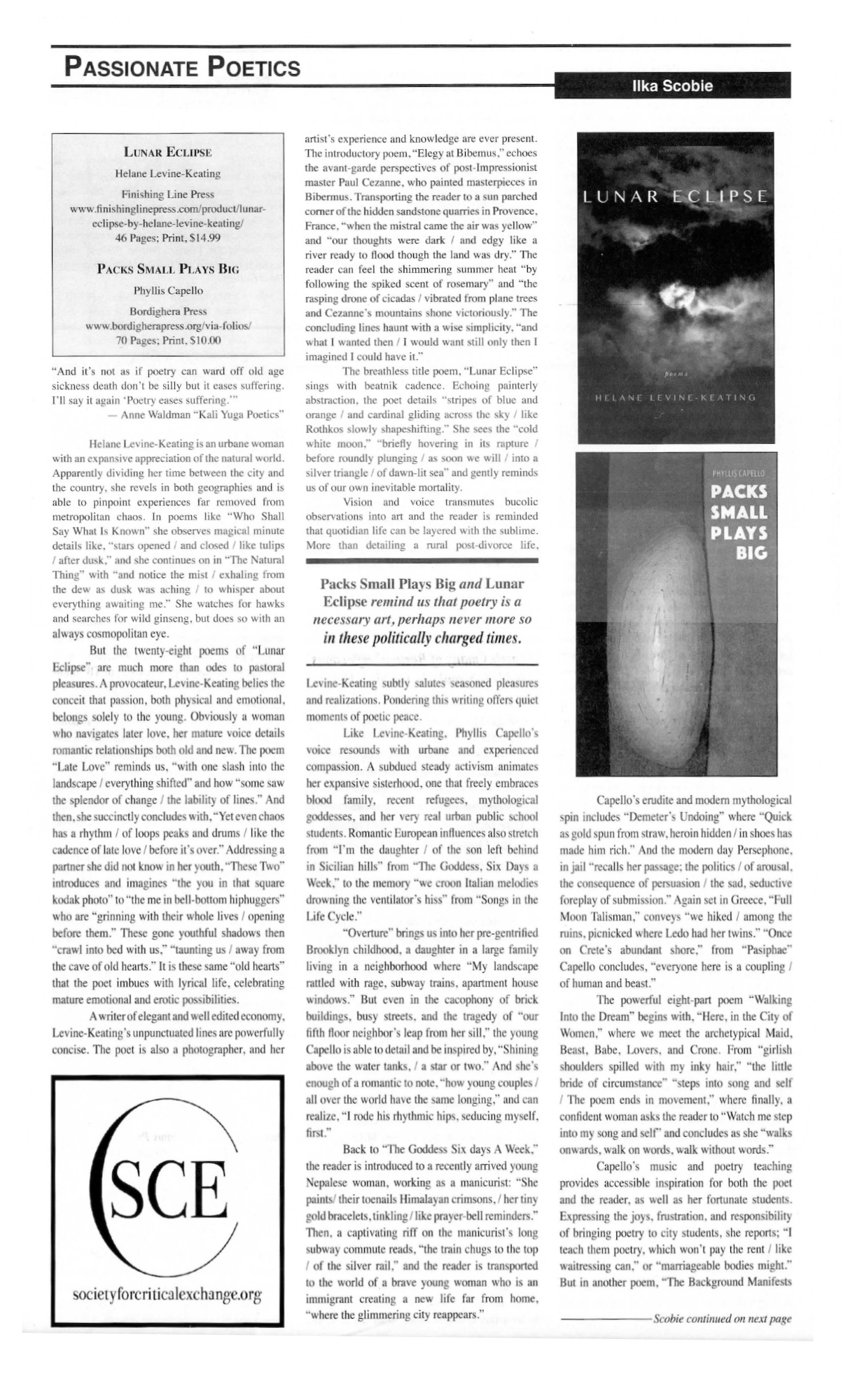
LUNAR ECLIPSE
Finishing Line Press, Georgetown, Kentucky
2018
46 pages, softcover
$14.99
USA - Order from Bookshop.org
USA - Order from Amazon
EU - Order from Blackwell's
ABOUT · REVIEWS · EXCERPTED POEMS
A writer of elegant and well edited economy, Levine-Keating's unpunctuated lines are powerfully concise.
The poet is also a photographer, and her artist's experience and knowledge are ever present.
Lunar Eclipse reminds us that poetry is a necessary art, perhaps never more so in these politically charged
times.
- Ilka Scobie, American Book Review, October 2019
> READ FULL TEXT OF ILKA SCOBIE'S REVIEW
"And it's not as if poetry can ward off old age sickness death don't be silly
but it eases suffering. I'll say it again "Poetry eases suffering.""
- Anne Waldman "Kali Yuga Poetics"
Helane Levine-Keating is an urbane woman with an expansive appreciation of the natural world.
Apparently dividing her time between the city and the country. she revels in both geographies
and is able to pinpoint experiences far removed from metropolitan chaos. In poems like "Who Shall Say What Is Known"
she observes magical minute details like. "stars opened / and closed / like tulips / after dusk," and she continues
on in "The Natural Thing with "and notice the mist / exhaling from the dew as dusk was aching / to whisper about
everything awaiting me". She watches for hawks and searches for wild ginseng, but does so with an always cosmopolitan eye.
But the twenty-eight poems of "Lunar Eclipse" are much more than odes to pastoral pleasures. A provocateur,
Levine-Keating belies the conceit that passion, both physical and emotional,
belongs solely to the young. Obviously a woman who navigates later love,
her mature voice details romantic relationships both old and new. The poem "Late Love"
reminds us, "with one slash into the landscape / everything shifted" and how "some saw the splendor of
change / the lability of lines." And then, she succinctly concludes with, "Yet even chaos has a
rhythm / of loops peaks and drums / like the cadence of late love / before it's over." Addressing a
partner she did not know in her vouth, "These Two" introduces and imagines "the you in that square kodak photo"
to "the mein bell-bottom hiphuggers" who are "grinning with their whole lives / opening before them."
These gone youthful shadows then "crawl into bed with us." "taunting us / away from
the cave of old hearts." It is these same "old hearts" that the poet imbues with lyrical life,
celebrating mature emotional and erotic possibilities.
A writer of elegant and well edited economy, Levine-Keating's unpunctuated lines are powerfully concise.
The poet is also a photographer, and her artist's experience and knowledge are ever present. The introductory
poem, "Elegy at Bibemus," echoes the avant-garde perspectives of post-Impressionist master Paul Cezanne,
who painted masterpieces in Bibermus. Transporting the reader to a sun parched corner of the hidden sandstone
quarries in Provence, France, "when the mistral came the air was yellow" and "our thoughts were dark / and edgy
like a river ready to flood though the land was dry." The reader can feel the shimmering summer heat "by
following the spiked scent of rosemary" and "the rasping drone of cicadas / vibrated from plane trees
and Cezanne's mountains shone victoriously." The concluding lines haunt with a wise simplicity, "and what I
wanted then / I would want still only then I imagined I could have it."
I could have it."
The breathless title poem. "Lunar Eclipse"
sings with beatnik cadence. Echoing painterly abstraction, the poet details "stripes of blue and orange / and
ardinal gliding across the sky / like Rothkos slowly shapeshifting."" She sees the "cold white moon." "briefly
hovering in its rapture / before roundly plunging / as soon we will / into a silvertriangle / of dawn-lit sea" and
gently reminds us of our own inevitable mortality.
Vision and voice transmutes bucolic observations into art and the reader is reminded that quotidian life can be layered with the sublime.
More than detailing a rural post-divorce life, Levine-Keating subtly salutes seasoned pleasures and realizations. Pondering this writing offers quiet moments of poetic peace.
Like Levine-Keating, Phyllis Capello's voice resounds with urbane and experienced
compassion. A subdued steady activism animates her expansive sisterhood, one that freely embraces
blood family, recent refugees, mythological goddesses, and her very real urban public school students.Romantic European influences also stretch
from "I'm the daughter / of the son left behind in Sicilian hills" from "The Goddess, Six Days a
Week," to the memory "we croon Italian melodies drowning the ventilator's hiss" from "Songs in the Life Cycle."
"Overture" brings us into her pre-gentrified Brooklyn childhood, a daughter in a large family living in a neighborhood where
"My landscape rattled with rage, subway trains, apartment house windows." But even in the cacophony of brick buildings, busy streets,
and the tragedy of "our fifth floorneighbor's leap from her sill," the young Capello is able to detail and be inspired by,
"Shining above the water tanks. / a star or two." And she's enough of a romantic to note, "how young couples/ all over the world
have the same longing." and can realize. "I rode his rhythmic hips, seducing myself, first."
Back to "The Goddess Six davs A Week." the reader is introduced to a recently arrived young Nepalese woman, working as a
manicurist: "She paints/ their toenails Himalayan crimsons, / her tiny gold bracelets, tinkling / like prayer-bell reminders."
Then. a captivating riff on the manicurist's long subway commute reads, "the train chugs to the top 1of the silver rail." and
the reader is transported to the world of a brave young woman who is animmigrant creating a new life far from home,
"where the glimmering city reappears."
Capello's erudite and modern mythological spin includes "Demeter's Undoing" where "Ouick
as gold spun from straw, heroin hidden / ni shoes has made him rich." And the modern day Persephone,
in jail "recalls her passage: the politics /o f arousal. the consequence of persuasion / the sad,
seductive foreplav of submission." Again set in Greece, "Full Moon Talisman." convevs "we hiked / among the
ruins. picnicked where Ledoh a d her twins." "Once on Crete's abundant shore." from "Pasiphae" Capello concludes,
"everyone here is a coupling I of human and beast."
The powerful eight-part poem "Walking Into the Dream" begins with, "Here, in the City of Women," where we
meet the archetypical Maid, Beast, Babe, Lovers, and Crone. From "girlish shoulders spilled with my inky
hair," "the little bride of circumstance "steps into song and self / The poem ends in movement," where finally,
a confident woman asks the reader to "Watch me step into my song and self" and concludes as she "walks onwards,
walk on words, walk without words."
Capello's music and poetry teaching provides accessible inspiration for both the poet
and the reader, as well as her fortunate students. Expressing the joys, frustration, and responsibility of
bringing poetry to city students, she reports; I" teach them poetry, which won't pay the rent / like
waitressing can," or 'mariageable bodies might." But ni another poem. "The Background Manifests the Figure," she
concludes that someone "can write a poem / that turns the straw of her life / into gold; no wing, just words." It is a
precise description of Capello's singular, symphonic voice and the gift she provides to her students.
While Capello's collection meanders from ancient and modern Greece to imagined harems, to fifth grade inner city classrooms,
and Levine- Keating maintains a more intimate and nature imbued focus,both poets share perceptively wrought voices.
I see these collections as part of a passionate poetic heritage, a sisterhood that echoes the work of Diane di Prima,
Marge Piercy, Gwendolyn Brooks, Hettie Jones,Janine Pomy Vega, andGrace Paley. Phyllis Capello and Helane Levine-Keating
embrace men, women, children, and the natural world with an exemplary and inclusive feminism. Revelatory details -
of subway stops, spring time forests, personal history, or sensual descriptions, powerfully evoke timeless female dreams and desires.
Packs Small Plays Big and Lunar Eclipse remind us that poetry is a necessary art, perhaps never more so in these politically charged
times. Educators and eyewitnesses, Levine-Keating and Capello - women of similar age and experience - have created
fulfilling and complicated lives which are depicted with warmth and bravery. The authors share a welcomed multitudinous
female wisdom, unveiling the affirmative wisdom and
pleasures of growing older. Both collections present meticulous crafted poems, resounding with transformative and contemporary power.
Born in Brooklyn, Ilka Scobie is now living in Soncino, a small town in northern Italy. She teaches poetry in the NYC public school system as part of City College's Poetry Outreach program. A Deputy
Editorof Live Mag!, she also writes contemporary art reviews for London Artlyst. Recent poetry readings have been at NYC's La Mama Theater and Howl Gallery.
.jpg)